

"At a technical level, AI does what it’s supposed to – but very few people think about the experience it delivers. And that’s a huge problem."
We spoke to Mazaru’s UX Content Specialist Lynsey Fyfe about the gap between AI deployment and customer experience.
Q: How aligned are the expectations of AI with the actual experience delivered? Is there a gap between technical deployment and experiential quality?
A: AI will deliver everything it's designed to deliver. It will reduce contact, cut costs, reduce friction. But 9 times out of 10, a company forgets to ask it to deliver a good customer experience. So on paper it's live, it’s stable, it’s reducing what it needs to reduce – but those aren't the best customer experiences.
⚠️ It's the moments within an experience that a customer remembers, not the delivery milestones. You might have shaved 4 seconds off the IVR, but your AI now talks so fast that no one remembers what the instructions were.
Q: Who controls customer-facing AI within an organisation, and what are the implications of this?
A: Ownership is usually quite fragmented, especially in bigger companies. You'll have IT who own the platform, product own the road map, the customer experience team own the outcomes, risk or compliance own the guardrails, and brand own the voice.
So the tech team might take control of one part of the journey, but they don't know how to make it sound like it's talking to a customer. Brand knows how it needs to sound, but not how to sync that up to all the AI’s different outputs.
And they’re all guided by different things – compliance care about the risk of bringing in AI. Customer experience care about the experience, of course, but they're constrained by budget, compliance, legal, even tech.
The upshot is that no one has ownership or oversight of the end-to-end customer experience; nobody knows what that looks like.
Q: What factors do companies underestimate in AI deployment?
A: One of the most underestimated aspects is language. For example, switching to generative AI from deterministic flow, companies often forget about implementing the lexicon or word choice.
They think the AI persona will cover that, but it'll deliver quite a bad experience until they change the main system prompt. So the language you feed an AI in terms of getting it to do what it's told is important.
🤓💡*For the non-AI nerds (we can’t all be Lynsey...): Deterministic is a rigid, "if-this-then-that" script. Generative can also be scripted, but with a reasoning brain that can think on the fly.
Remember: Timing is also crucial.
"This isn’t something that you can just polish at the end of the process, because it’ll put you back to the beginning."
If you start changing your AI’s persona or behaviour at the end, you're looking at more rounds of UAT testing, guardrail testing, stress testing, and all the associated costs.
Q: As AI becomes embedded across channels, what are the risks if the customer experience isn’t actively governed?
A: When customer experience becomes inconsistent, it very quickly erodes established trust in your brand, and that loses you customers. If you phoned a company two, three times, and you never knew each time what kind of experience you were going to have, in the end you’d just stop phoning and next time, you’d go somewhere else.
If AI isn’t governed alongside CX, if there’s inconsistency between channels, the brand voice starts to drift, the customer experience suffers, and the whole thing unravels.
"Using your brand identity to stand out is just smart business, but if you haven't made sure your AI is keeping up, you fade into the background before you know it. You've sunk to page 632 in a Google search."
Often an organisation will think they don't need to worry about AI because it takes care of the calls – but it isn’t just a ‘set and forget’ thing. You have to nurture it, optimise it, review your data.
Companies get very excited about AI’s scalability, but as soon as you scale up, you're also scaling up any inconsistencies, and that will have a knock-on effect on brand trust and customer loyalty.
Q: What about the companies who do it right?
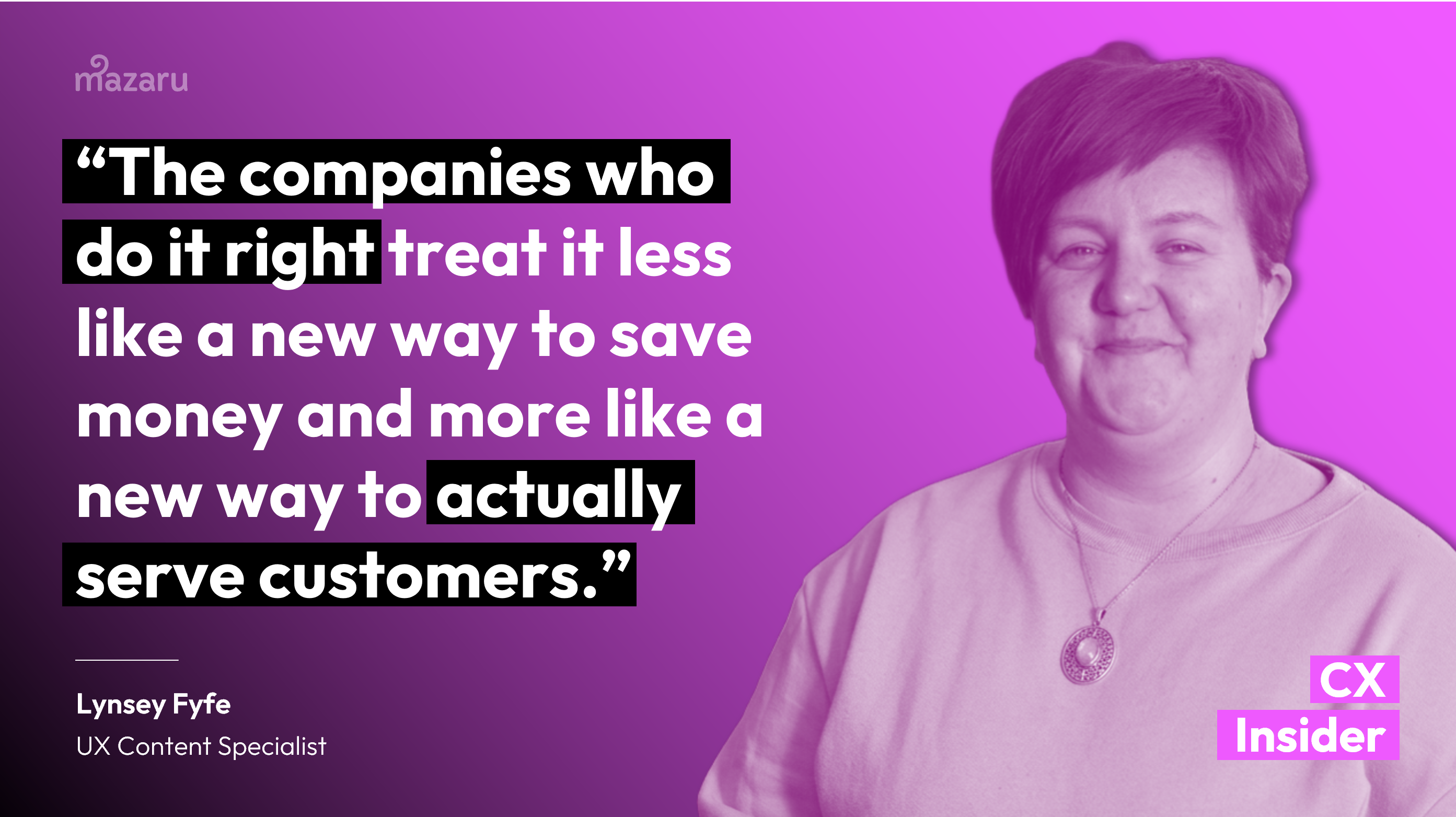
A: The companies that do it right are rolling AI out intentionally. They don't just throw AI at a problem and expect a silver bullet fix for every problem. They treat it less like a new way to save money, and more like a new way to actually serve their customers.
🧠 You can reduce cost, scale AI, and hit every performance metric.
And still lose the customer.
So what exactly is your AI optimised for?
🎁 Get a free CX chat
If your AI is technically stable but the experience feels fragmented, let’s talk about how to bridge the gap.